April 14, 1935 — The Worst Dust Storm in American History
The morning of April 14, 1935 was unusually pleasant across the southern Great Plains. After weeks of brutal dust storms that had turned the skies brown and driven families from their homes, the day dawned clear and warm. People who had been cooped up inside during the preceding storms ventured out. Children played outside. Families went to church and visited neighbors. For a few hours, it seemed as though the worst might be over.
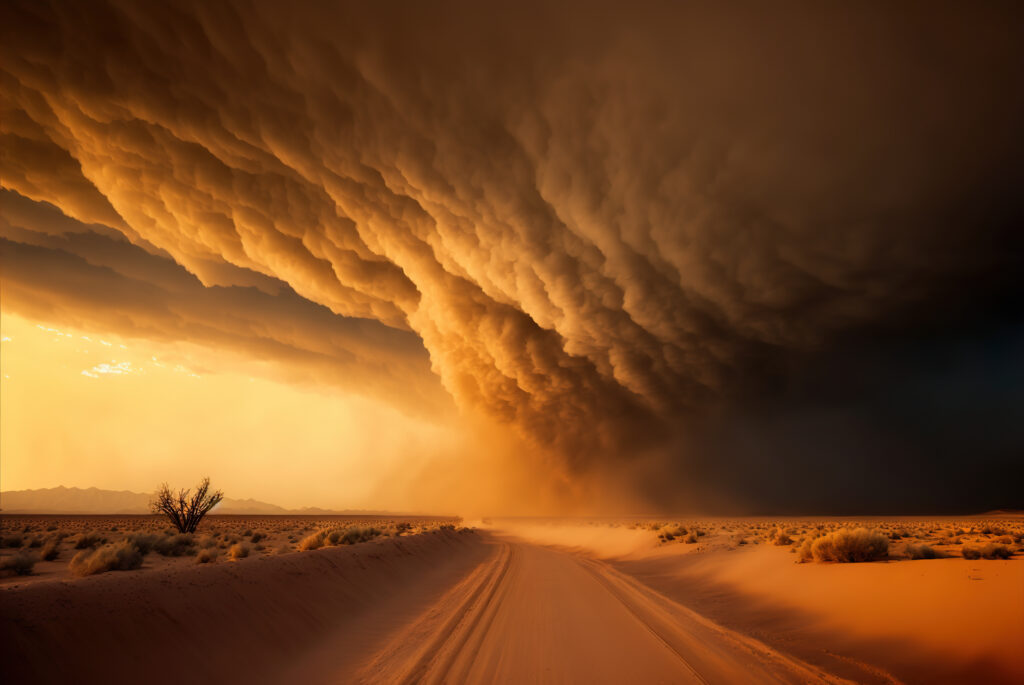
Then, around mid-afternoon, witnesses to the north reported something approaching on the horizon: a wall of darkness stretching from ground to sky, rolling southward at 60 miles per hour. It wasn’t a storm cloud in any conventional sense. It was a moving mountain of dust — estimated at 200 feet tall in some accounts, a mile high in others — that blotted out the sun completely as it passed. By the time it reached Dodge City, Kansas and Amarillo, Texas, the sky had turned so black that people who were caught outside couldn’t see their hands in front of their faces.
The day became known as Black Sunday, and the storm it produced was the single most severe dust storm of the Dust Bowl era — a decade-long environmental catastrophe that transformed the Great Plains into one of the worst man-made ecological disasters in American history.
How the Dust Bowl Was Made
The Dust Bowl didn’t arrive as a natural disaster. It was the predictable consequence of agricultural decisions made across millions of acres of Great Plains land in the years and decades before the 1930s.
The southern Great Plains — eastern Colorado, western Kansas, the Oklahoma and Texas panhandles, and northeastern New Mexico — is an ecosystem adapted to periodic drought. Its native shortgrass prairie had evolved specifically to survive dry conditions: deep root systems that held soil in place during droughts and winds, and grasses that went dormant rather than dying during dry spells, ready to recover when rains returned.
Beginning in the late 1800s and accelerating dramatically during and after World War I, when grain prices were high and the federal government encouraged agricultural expansion, farmers broke that native sod and replaced it with wheat. By the late 1920s, 32 million acres of native grassland had been plowed under across the southern Plains. The deep root systems that held the soil were gone. In their place were wheat fields that, when drought came and the crops failed, left bare, dry, unanchored topsoil exposed to the wind.
Drought came in 1931 and didn’t leave for most of the decade. Without crops, without root systems, and without the moisture that would have given the fine Plains soil some cohesion, the topsoil simply blew away. Dust storms that had been occasional nuisances became routine, then catastrophic, then constant.
The Physics of a Dust Storm
Understanding what physically happened on Black Sunday requires understanding how dust storms build. The process begins with wind — specifically, wind strong enough to overcome the inertia of soil particles and lift them into the air.
Soil particles are lifted through a process called saltation: wind rolls the lightest particles along the surface, and when they collide with other particles, they launch them into the air. Those airborne particles collide with more surface particles upon landing, launching more material upward. The process is self-amplifying — the more material in the air, the more surface disturbance, the more material launched.
The cold front that produced Black Sunday was unusually powerful for April. A mass of Arctic air surging south collided with the warm air that had made the morning pleasant, generating violent surface winds. In the absence of any vegetation or surface moisture to resist them, those winds stripped the exposed topsoil immediately. The resulting dust cloud — carrying an estimated 300,000 tons of topsoil — was so dense that it produced static electricity as particles collided, disabling car engines, interfering with radio signals, and delivering shocks to people and animals caught in the open.
The wall of darkness witnesses described was real: the dust was dense enough to reduce light to zero at ground level. Observers in Amarillo reported total darkness lasting approximately 40 minutes as the storm passed. Birds that were caught in flight dropped to the ground, unable to navigate. Rabbits and other animals ran ahead of the storm wall in panic.
What People Experienced
The Associated Press reporter Robert Geiger was in Boise City, Oklahoma that day. His dispatch the following day used the phrase “dust bowl” to describe the region — the first time that term appeared in print, and the name that would define the era.
For the people living through it, Black Sunday was terrifying in a way that exceeded even the storms that had come before. Witnesses described the approaching wall as looking like a black tidal wave, like the end of the world, like nothing they had any reference for. Many people caught outdoors were temporarily blinded by the static-charged dust. Several died — some from suffocation, some from car accidents in the sudden total darkness, some from heart failure.
Families sheltered in their homes stuffed wet rags under doors and around windows, but the fine Plains dust penetrated everything. People woke the following morning to find their dishes full of grit, their food inedible, their lungs raw. Children developed a condition called “dust pneumonia” from inhaling the fine silica particles — a respiratory illness that killed hundreds over the course of the Dust Bowl years.
The Human Exodus
Black Sunday accelerated an exodus from the southern Plains that had been building for years. An estimated 2.5 million people left the Dust Bowl region during the 1930s, many of them traveling to California in search of agricultural work. These migrants — called “Okies” regardless of which state they came from, a term used with contempt by the Californians they encountered — formed one of the largest internal migrations in American history.
The conditions they left behind and the hardships they encountered became defining experiences of the Depression era, documented by Dorothea Lange’s photographs and John Steinbeck’s novel The Grapes of Wrath. The image of a farm family piling their possessions onto a car and heading west, abandoning land that had been their livelihood, was the human face of an environmental catastrophe that was entirely preventable.
What Changed — and What Didn’t Entirely
Black Sunday had an immediate political impact. Photographs of the dust storm reached Washington within days, and within weeks Congress passed the Soil Conservation Act of 1935, establishing the Soil Conservation Service and funding programs to plant windbreaks, teach farmers soil conservation practices, and retire the most vulnerable land from crop production. It was one of the fastest environmental policy responses in American history, driven by the undeniable visual evidence of what unchecked soil erosion could do.
The Dust Bowl eventually ended when rains returned in the late 1930s, and conservation programs helped stabilize much of the region’s soil. But the fundamental tension between Great Plains agriculture and the region’s climate never fully resolved. Drought returned to the region in the 1950s, causing significant dust storm activity again. The Ogallala Aquifer, which underlies much of the same region and has enabled irrigation that keeps the current agricultural system functional, is being depleted significantly faster than it recharges — a slow-motion version of the same extractive pressure that created the Dust Bowl.
The lesson of Black Sunday was written in 300,000 tons of topsoil scattered across the sky on a warm April afternoon. Whether it has been fully learned remains an open question.