The Same Snow, Different Melting Rates
Watch snow fall in December and it might linger for weeks, gradually disappearing through sublimation or melting during brief warm spells. But snow that falls in March or early April often vanishes within days—sometimes within hours—even when air temperatures are similar to those winter months. A six-inch March snowfall can be gone by the next afternoon, while the same accumulation in January would have persisted much longer.
This difference isn’t your imagination, and it’s not just about warmer spring temperatures. The primary driver is something most people overlook: the sun’s angle and intensity change dramatically between December and March. Even when thermometer readings are identical, spring sunlight carries far more energy than winter sunlight, and this solar radiation becomes the dominant factor in snow melt once days begin lengthening.
The Sun’s Angle Changes Everything
The sun’s path across the sky changes throughout the year as Earth orbits while tilted on its axis. During winter in the Northern Hemisphere, the sun traces a low arc—rising in the southeast, staying low in the southern sky, and setting in the southwest. At the winter solstice (around December 21), the sun reaches its lowest angle and shortest time above the horizon.
By late March, approaching the spring equinox, the sun rises nearly due east and sets nearly due west, climbing much higher in the sky at midday. This higher angle means sunlight strikes the ground more directly rather than at a shallow angle.
When sunlight hits at a steep angle, its energy is concentrated in a smaller area. Think of shining a flashlight directly down on a table versus at a low angle—the direct beam creates a small, bright spot while the angled beam spreads over a larger, dimmer area. The same principle applies to solar radiation.
Winter’s low-angle sunlight spreads its energy over a larger surface area, delivering less heat per square foot. Spring’s higher-angle sunlight concentrates energy in a smaller area, delivering significantly more heat per square foot—even when the total amount of radiation leaving the sun remains constant.
Day Length Amplifies the Effect
Not only does spring sun shine more directly, it shines for longer periods. In mid-December at 40° north latitude (roughly New York, Denver, or Indianapolis), daylight lasts about 9 hours. By late March, daylight extends to 12 hours—one-third more time for the sun to deliver energy.
This combination—higher angle plus longer duration—means a typical spring day delivers dramatically more total solar energy than a winter day. Even if air temperature is the same (say, 35°F in both December and March), the snow receives far more radiant energy in spring, causing faster melting.
The effect is more pronounced at higher latitudes. Northern cities experience even greater differences in sun angle and day length between winter and spring, making the spring melt acceleration even more dramatic.
Solar Radiation Versus Air Temperature
Many people focus on air temperature as the primary driver of snow melt, but solar radiation often matters more, especially on clear days. Snow can melt rapidly even when air temperature remains below freezing if strong sunlight provides sufficient radiant energy.
This is why south-facing slopes lose snow much faster than north-facing slopes at the same elevation and air temperature. The south-facing slope receives direct sunlight for more hours and at higher angles, while the north-facing slope remains shaded or receives only low-angle sun.
Similarly, snow under trees or on the north side of buildings persists much longer than snow in open, sunny areas. The sheltered snow experiences the same air temperature but receives far less solar radiation.
In spring, the combination of higher sun angle and longer days means even partially cloudy conditions deliver more solar energy than bright winter days, accelerating melt rates beyond what air temperature alone would predict.
Snow’s Reflectivity Changes With Age
Fresh snow is highly reflective (high albedo), bouncing back 80-90% of incoming sunlight. This reflectivity helps fresh snow resist melting—most solar energy is reflected away rather than absorbed as heat.
However, snow’s reflectivity decreases as it ages. Dust and debris settle on the surface. Partial melting and refreezing create larger ice crystals. Pollen and organic material accumulate. The snow surface darkens and roughens.
Darker, older snow absorbs more solar radiation—potentially 40-60% instead of the 10-20% absorbed by fresh snow. This absorbed energy accelerates melting.
Spring snow often falls on ground that’s already seen some melting cycles, with dust and debris from previous snow exposed at the surface. The new snow mixes with this contaminated old snow, reducing overall reflectivity. Additionally, spring brings increased pollen, dust storms, and atmospheric particulates that dirty snow more quickly than winter precipitation.
The result is that spring snow typically has lower albedo than winter snow, absorbing more of the abundant spring sunlight and melting faster as a consequence.
Ground Temperature Plays a Role
Through winter, the ground freezes progressively deeper as sustained cold penetrates downward. By February or March, the frost layer might extend several feet deep in cold climates, creating a frozen base that insulates against deeper ground warmth.
This frozen ground provides no heat to overlying snow—if anything, it acts as a heat sink, keeping snow colder. Snow sitting on frozen February ground must lose heat to both the cold air above and the frozen earth below.
By late March and April, warming air temperatures and spring sun begin thawing the surface soil layers. The ground transitions from a heat sink to a heat source, conducting warmth upward from deeper layers that never froze. Snow now sits on ground that’s actively warming, accelerating bottom-melt that wouldn’t occur on frozen winter ground.
This ground warming is particularly noticeable on pavement and other dark surfaces that absorb solar radiation readily. A March snowfall on asphalt or dark soil melts from the bottom up as these surfaces absorb spring sunlight and conduct heat into the overlying snow. The same surfaces in January, frozen solid, provide no such heat source.
Spring Rain Accelerates Melt
Spring weather patterns often bring rain, sometimes falling as rain on snow. This accelerates melting dramatically through several mechanisms:
Rainwater is typically warmer than snow (often 40-50°F), delivering substantial thermal energy when it falls on and infiltrates through the snowpack. Each raindrop releases its heat to the surrounding snow.
Rain saturates snow, replacing air spaces with water. This dramatically increases thermal conductivity, allowing heat to move through the snowpack more efficiently. Dry snow insulates itself; wet snow conducts heat readily.
Rain creates surface water flow that carries heat horizontally across the snow surface and vertically through the pack, distributing thermal energy that would remain localized if only melting from sunlight.
Rain events are more common in spring than midwinter because warmer air masses can hold more moisture, and storm tracks often bring maritime air with above-freezing temperatures. The combination of spring sun and rain creates the most rapid melt scenarios, often causing flooding when large snowpacks disappear within days.
Why This Matters for Flood Risk
Understanding spring melt acceleration has practical implications for flood forecasting and safety. Flood risk is highest in spring not just because snowpacks are largest (winter actually sees peak snow accumulation in many regions), but because melting accelerates dramatically.
A large January snowpack melts gradually over weeks or months, releasing water at rates rivers and drainage systems can handle. The same size snowpack in late March might melt in a week or less, overwhelming the same systems with rapid runoff.
Add spring rain to a melting snowpack and flood risk increases further. Forecasters must account for both the water already stored in snow and the incoming precipitation, plus the accelerated melt rate caused by longer days, stronger sun, and warmer ground.
This is why flood warnings are most common in March and April despite winter having more total snow on the ground in many locations.
The Visual Transformation
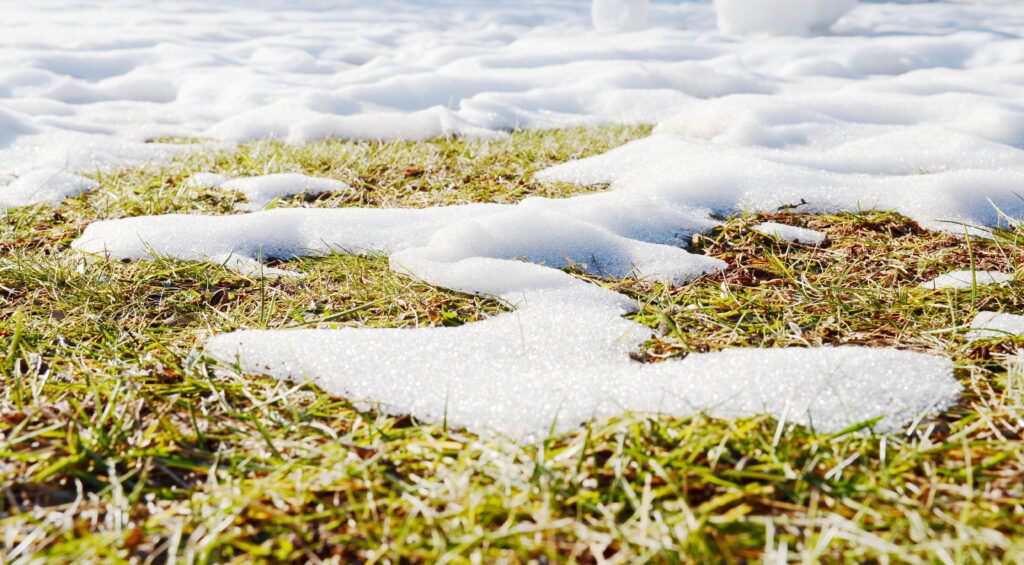
The rapid spring melt creates one of winter’s most dramatic transformations—landscapes white with snow can return to brown or green within days. This visual change signals the true transition between seasons better than calendar dates or temperature alone.
Notice next time how a late-season snowfall disappears faster than early-winter snow, even when the weather feels similarly cold. You’re watching the difference between winter sun struggling to deliver energy at low angles for short periods, and spring sun attacking snow with hours more intensity daily, aided by warming ground and increasing contamination of the snow surface.
When Spring Feels Like Winter
Occasionally, spring snowfalls coincide with unusual conditions—deep cold, cloudy weather, fresh snow on frozen ground. In these cases, spring snow can persist longer than expected because the normal spring advantages are temporarily absent.
But these are exceptions. As soon as typical spring conditions return—clear skies allowing strong sunlight, warming ground, longer days—the accumulated snow disappears rapidly, sometimes catching people off-guard who expected it to linger like winter snow.
A Sign of Changing Seasons
The next time a late-season snowstorm hits and you hear people say “it’ll be gone by tomorrow,” they’re likely right—not just hopeful. Spring snow faces an enemy that winter snow doesn’t: powerful sunlight attacking it for 12+ hours daily, combined with warming ground and reduced reflectivity.
The same six inches that would have lingered for weeks in December disappears in a day or two in March because the sun has changed. Not the sun itself, but Earth’s orientation to it, delivering solar energy at angles and durations that make snow survival impossible except in the coldest or most sheltered locations.
It’s a reminder that seasons change not primarily through air temperature but through solar geometry—the angle at which Earth receives the sun’s rays. By the time March arrives, winter has mathematically lost the battle, even if cold air temperatures occasionally make brief counterattacks. The strengthening sun has already determined the outcome, and snow’s rapid spring disappearance is simply the visible evidence of physics winning over weather.