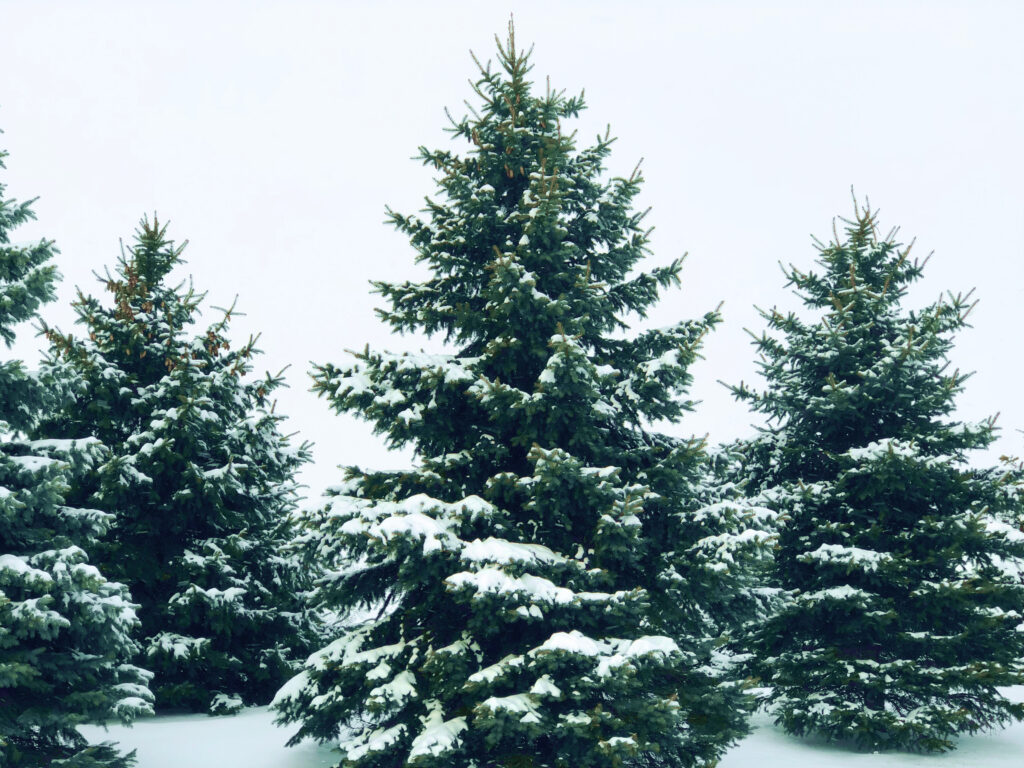
The Trees That Defy Winter
Walk through a winter forest and most trees stand bare, their branches skeletal against gray skies. But scattered among the deciduous trees are evergreens—pines, spruces, firs—still clothed in green needles, seemingly unbothered by the cold that stripped their neighbors of every leaf. This persistence seems almost defiant, as if evergreens refuse to acknowledge winter’s arrival.
The common assumption is that evergreens simply evolved a way to tolerate cold that deciduous trees lack, allowing them to keep their foliage year-round. But the reality is more complex and more interesting. Evergreens don’t keep their needles because they’re tougher or more cold-resistant—they keep them because they’ve made a completely different evolutionary calculation about the costs and benefits of maintaining leaves versus dropping them.
Deciduous Trees Drop Leaves to Survive
To understand why evergreens keep their needles, you first need to understand why deciduous trees drop their leaves. It’s not primarily about cold tolerance—many tree leaves can survive freezing without damage. The real problem is water.
During winter, water in the soil freezes, making it unavailable to tree roots. At the same time, leaves continue to lose water through transpiration—the evaporation of moisture from leaf surfaces. A tree with leaves in winter would be trying to replace lost water from a frozen reservoir it can’t access, leading to dehydration and death.
Deciduous trees solve this problem by dropping their leaves before winter. Without leaves, water loss drops to nearly zero. The tree can survive months without access to liquid water because it’s not losing water to transpiration.
Additionally, broad, flat leaves are vulnerable to physical damage from snow and ice accumulation. The weight of snow on a full canopy of summer leaves would break branches. Dropping leaves before winter eliminates this risk.
Evergreen Needles Are Different From Leaves
Evergreen needles might look like they’re just narrow leaves, but they’re fundamentally different structures designed to minimize water loss while still allowing photosynthesis.
Needles have a thick waxy coating (cuticle) that makes them nearly waterproof. Water loss through this coating is minimal compared to broad deciduous leaves. The needle’s shape—narrow with minimal surface area—further reduces water loss. Stomata (the pores that allow gas exchange for photosynthesis) are recessed in grooves along the needle, protected from drying winds.
This structure allows evergreens to maintain foliage through winter without catastrophic water loss. They do lose some water, but at rates low enough that their roots can replace it during brief thaws when soil water becomes accessible, and low enough that they can tolerate the deficit during frozen periods.
The needles are also flexible and strong, designed to shed snow rather than collect it. Snow slides off the narrow, waxy needles before accumulating to damaging levels. Even when snow does accumulate, the smaller surface area of needles compared to broad leaves means less total weight.
The Real Advantage: Getting a Head Start
The key benefit of keeping needles year-round isn’t winter survival—it’s being ready for spring. Deciduous trees must grow an entire new set of leaves every spring before they can begin serious photosynthesis. This requires substantial stored energy and time. Evergreens already have their photosynthetic machinery in place.
As soon as conditions become favorable in early spring—sometimes even on warm winter days—evergreens can begin photosynthesis immediately. They get weeks or even months of additional growing season compared to deciduous trees that are still sprouting leaves.
In harsh climates with short growing seasons, this head start is crucial. Evergreens can photosynthesize whenever conditions allow—a warm February day, early March sunshine—while deciduous trees must wait for sustained warmth to trigger leaf development.
This advantage is why evergreens dominate in northern forests (boreal/taiga) and high elevations where growing seasons are short. The longer the winter relative to summer, the more valuable it becomes to maintain photosynthetic capacity year-round.
Needles Last Multiple Years
Evergreen needles aren’t permanent—they do eventually fall off and get replaced. But unlike deciduous leaves that last one growing season, needles typically remain on the tree for 2-5 years, depending on species. Some bristlecone pine needles last over 40 years.
This longevity means evergreens don’t need to rebuild their entire photosynthetic apparatus annually. The investment in creating a needle pays dividends for multiple years. The tree recycles nutrients from old needles before dropping them, then grows new needles gradually to replace what’s lost.
This strategy works because needles are durable. Their thick cuticle and structural design allows them to withstand years of exposure to sun, wind, rain, and snow without breaking down. Broad deciduous leaves, being thin and delicate, couldn’t survive multiple seasons—they’d be shredded by weather long before their second spring.
The Trade-Offs of Being Evergreen
Keeping needles year-round isn’t purely advantageous—evergreens make significant trade-offs for this strategy:
Lower photosynthetic rate: Needles photosynthesize less efficiently than broad leaves. The thick waxy coating that prevents water loss also limits how much CO₂ can enter for photosynthesis. The small surface area means less total light collection. Evergreens typically photosynthesize at 25-50% the rate of deciduous trees per unit of leaf area.
Nutrient constraints: Because needles last multiple years and are nutrient-rich, a large portion of the tree’s nutrients are tied up in existing foliage. Evergreens grow more slowly than deciduous trees and require soils with good nutrient availability.
Susceptibility to certain stresses: The needles evergreens keep through winter can be damaged by extreme conditions. Winter desiccation (when water loss exceeds replacement) can kill needles or entire branches. Ice storms can break branches loaded with needles and ice.
Shade tolerance trade-offs: Many evergreens are less shade-tolerant than deciduous trees because their needles are less efficient at capturing limited light. They do better in open areas or as canopy dominants than as understory trees.
Why Some Deciduous Trees Exist Where Evergreens Dominate
If evergreens have advantages in cold climates, why do deciduous trees exist in those regions at all? Because deciduous strategies have their own advantages:
Nutrient recycling: Dropping leaves allows trees to recycle nutrients back through leaf litter decomposition. In nutrient-poor soils, this cycling can be valuable.
Pest and disease avoidance: Many pests and diseases overwinter on foliage. Dropping all leaves annually eliminates this year-to-year carryover.
Damage avoidance: In areas with heavy ice storms or other mechanical stresses, dropping leaves reduces vulnerability to physical damage.
Fast growth potential: In areas with adequate growing season length, deciduous trees can outcompete evergreens by growing faster during summer using their more efficient broad leaves.
The result is that in most temperate forests, you find a mix of strategies, with the balance shifting based on local conditions. Colder, shorter growing seasons favor evergreens. Longer, warmer growing seasons favor deciduous trees.
Not All Evergreens Are Conifers
While most familiar evergreens are conifers (pines, spruces, firs) with needles, some broad-leaved trees are also evergreen. Holly, rhododendron, and many tropical trees maintain leaves year-round.
These broad-leaved evergreens use the same basic strategy as conifers—maintaining photosynthetic capacity year-round—but with leaves rather than needles. They succeed where winters are mild enough that water stress isn’t severe, and where their broad leaves can be protected from mechanical damage.
In truly harsh climates, however, the needle strategy dominates because only needles can adequately minimize water loss and physical damage while maintaining photosynthetic function.
Larches: The Exception That Proves the Rule
One group of conifers—larches (also called tamaracks)—are deciduous despite having needles. They drop all their needles every fall and grow new ones each spring. This might seem contradictory, but it makes sense in their ecological niche.
Larches often grow in wet, cold areas where soil water remains accessible even in winter, reducing the water stress advantage of evergreen needles. They also tend to grow in nutrient-rich wetland soils where the nutrient cost of replacing all needles annually isn’t as limiting.
By dropping needles, larches avoid winter desiccation damage (a problem for evergreens in extremely cold, dry, or windy sites) and can invest in faster growth during the growing season. They represent an alternative strategy that works in specific conditions.
A Strategy, Not Superiority
Evergreen trees don’t keep their needles through winter because they’re stronger or more resilient than deciduous trees. They keep their needles because it’s a successful evolutionary strategy in environments where growing seasons are short and being ready to photosynthesize at the earliest opportunity provides a competitive advantage.
Deciduous trees aren’t weaker or less successful—they’ve simply optimized for different conditions, investing in maximum photosynthetic efficiency during the growing season rather than year-round readiness.
The winter forest contains both strategies coexisting because neither is universally superior. Each works best under different circumstances, and the mix you see reflects the local balance of growing season length, water availability, nutrient levels, and other factors.
Still Alive, Just Slower
The next time you see evergreen trees in winter, remember that they’re not dormant—they’re waiting. Those needles, still green beneath any snow that covers them, are ready to begin photosynthesis the moment conditions allow. On any warm winter day, photosynthesis may actually be occurring, capturing energy while deciduous neighbors stand bare and inactive.
The needles will remain through winter, through spring leaf-out of deciduous trees, through summer growth, and into next fall before gradually being replaced. They’re an investment that pays dividends for years, allowing the tree to maintain readiness without the annual rebuilding cost deciduous trees must pay.
The trees haven’t defied winter—they’ve simply made a different calculation about how to survive it, one that involves persistence rather than retreat, year-round readiness rather than seasonal renewal, and durability rather than replacement. It’s a strategy that’s served them well for millions of years in the world’s coldest forests, where being first to spring and ready for any opportunity makes the difference between thriving and merely surviving.