An Observation That Defies Logic
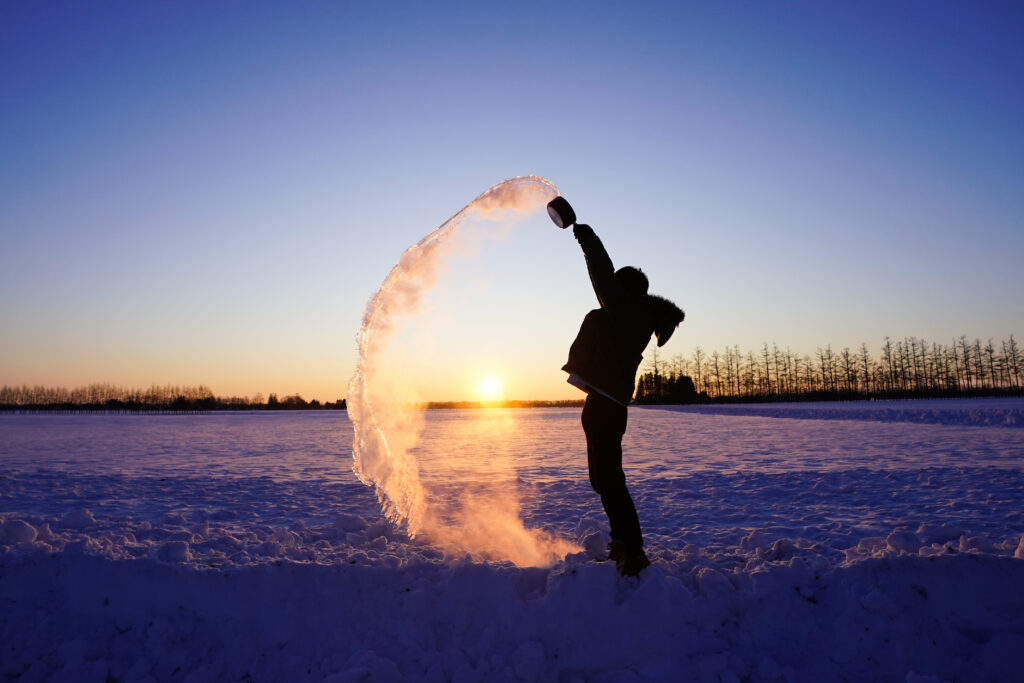
Pour two identical containers of water into a freezer—one filled with hot water at 180°F and the other with cold water at 70°F. Common sense says the cold water should freeze first. After all, it has less distance to travel down the temperature scale to reach 32°F. Yet under certain conditions, the hot water can freeze first, sometimes significantly faster than the cold water.
This counterintuitive phenomenon is called the Mpemba effect, named after a Tanzanian student who brought it to scientific attention in the 1960s. The effect has puzzled scientists for decades because it seems to violate basic physics—how can something that starts warmer end up frozen sooner than something that starts cooler? The answer, it turns out, involves multiple mechanisms that can give hot water surprising advantages in the race to freeze.
The History Behind the Name
The phenomenon is named after Erasto Mpemba, who as a schoolboy in Tanzania in 1963 noticed that hot ice cream mix froze faster than cold mix when making ice cream. When he mentioned this observation to a visiting physics professor, Dr. Denis Osborne, they investigated together and published their findings in 1969.
However, Mpemba wasn’t the first to notice this effect. Aristotle wrote about it over 2,000 years ago. Francis Bacon mentioned it in the 17th century. René Descartes discussed it. But these historical observations were mostly anecdotal and not systematically studied. Mpemba’s contribution was bringing the phenomenon to modern scientific attention and inspiring rigorous investigation.
Despite decades of research since then, scientists still don’t fully agree on all the mechanisms behind the effect or the exact conditions required for it to occur. The Mpemba effect remains one of those frustrating phenomena that’s easy to observe but difficult to explain completely.
Evaporation: The Most Obvious Factor
One of the clearest mechanisms that can make hot water freeze faster is evaporation. Hot water evaporates more readily than cold water, and this evaporation removes mass from the container. With less water remaining, there’s less total mass that needs to be frozen.
When water evaporates, it also removes heat from the remaining water through evaporative cooling—the same process that cools you when sweat evaporates from your skin. The most energetic water molecules escape as vapor, leaving behind cooler molecules.
If you start with 100 grams of hot water that loses 10 grams to evaporation, you’re left with 90 grams that needs to freeze. The cold water starting with 100 grams still has nearly 100 grams to freeze (it evaporates too, but much more slowly). Even though the hot water had to cool from a higher temperature, having less total mass to freeze can allow it to finish first.
However, evaporation alone can’t explain all observations of the Mpemba effect, especially in sealed containers where evaporation is prevented or minimal. Other mechanisms must be at work.
Convection Currents and Heat Distribution
Hot water creates stronger convection currents than cold water. As hot water sits in a freezer, the water at the top cools faster because it’s exposed to cold air. This cooled water becomes denser and sinks, while warmer water rises to replace it, creating circulation throughout the container.
These vigorous convection currents distribute cold more evenly throughout hot water than occurs in the initially cold water container, where temperature differences are smaller and circulation is weaker. The hot water container may cool more uniformly, preventing the formation of insulating layers of nearly-frozen water at the top that would slow further cooling.
Cold water, starting with smaller temperature differences between top and bottom, develops weaker convection. It may form an insulating layer of very cold water at the surface that slows heat loss from the warmer water below, essentially creating a barrier that protects the bulk of the water from efficient cooling.
This mechanism is controversial and depends heavily on container geometry and placement in the freezer, but convection differences likely contribute to the Mpemba effect in some situations.
Supercooling and Nucleation
Water doesn’t always freeze at exactly 32°F. Pure, undisturbed water can remain liquid well below the freezing point in a state called supercooling. For freezing to begin, ice crystals need nucleation sites—impurities, rough surfaces, or disturbances that trigger crystal formation.
Hot water that has been heated may have fewer dissolved gases (which boiled out during heating) and fewer nucleation sites available. Paradoxically, this can sometimes cause hot water to supercool more readily than cold water, remaining liquid at temperatures below freezing.
However, once nucleation finally occurs in supercooled water, freezing happens rapidly as all that overcooled water suddenly crystallizes. This can create situations where hot water remains liquid longer but then freezes very quickly once ice formation begins.
The role of supercooling in the Mpemba effect is complex and can work in either direction depending on circumstances. It may explain why some experiments see the effect while others don’t—the presence or absence of nucleation sites varies between experiments.
Dissolved Gases Make a Difference
Cold water holds more dissolved gases (oxygen, nitrogen, carbon dioxide) than hot water. When water is heated, these gases are driven out. If you compare freshly heated water to water that has been cold all along, the hot water contains less dissolved gas.
Dissolved gases can affect freezing in several ways. They may influence ice crystal formation and the temperature at which freezing begins. Water with less dissolved gas may have different thermal properties or freeze in ways that change how quickly the entire volume solidifies.
Additionally, as water freezes, dissolved gases are excluded from the ice structure and concentrate in the remaining liquid. This changes the properties of the unfrozen portion, potentially affecting freezing rates. Hot water starting with less dissolved gas would experience less of this complicating effect.
Heat Loss Rates Aren’t Linear
The rate at which an object loses heat depends on the temperature difference between the object and its surroundings. Hot water in a freezer has a much larger temperature difference with the freezer air than cold water does, so initially, hot water loses heat much faster.
While this seems like it should just mean the hot water cools quickly to catch up with the cold water (and then both freeze at the same rate), the actual dynamics are more complex. The initially faster cooling of hot water can affect ice crystal formation, convection patterns, and other factors in ways that persist even after the temperatures have equalized.
There’s also a question of thermal inertia and how different temperature histories affect the freezing process. Water that cooled rapidly from hot temperatures may be in a slightly different physical state than water that was always cold, even when both reach the same temperature. These subtle differences might influence subsequent freezing.
Container and Environment Matter Enormously
One reason the Mpemba effect is difficult to study consistently is that it depends heavily on experimental conditions. Small changes in container shape, material, placement in the freezer, air circulation, and dozens of other factors can determine whether hot water freezes faster or not.
In some experimental setups, hot water reliably freezes first. In others, cold water always wins. In many cases, the results are inconsistent or the difference is too small to measure reliably. This sensitivity to conditions frustrates efforts to definitively prove or explain the effect.
For example, if hot water sits in a freezer where cold air blows directly on it, evaporation and convection might give it a significant advantage. In a still freezer with minimal air movement, these advantages might disappear, and cold water would freeze first as logic suggests.
The container material matters too. A metal container conducts heat well and might eliminate some of the convection advantages. A plastic or glass container with poor thermal conductivity might preserve temperature gradients that favor hot water in certain scenarios.
The Effect Isn’t Always Reliable
An important caveat: the Mpemba effect doesn’t always occur, and when it does, the time difference is often small. In many situations, cold water freezes faster as expected. The effect appears to require specific conditions that aren’t always present or aren’t always controlled in casual observations.
This makes the Mpemba effect frustrating for both scientists trying to study it and people trying to demonstrate it. You can’t simply put hot and cold water in a freezer and reliably expect the hot water to freeze first. Sometimes it does, sometimes it doesn’t, and predicting when requires understanding all the variables involved.
Some scientists have questioned whether the Mpemba effect is even a real phenomenon or just an artifact of measurement errors, uncontrolled variables, or confirmation bias. However, enough careful studies have documented it under controlled conditions that most researchers accept it occurs—they just disagree about why.
Recent Research and Debates
Scientific interest in the Mpemba effect has increased in recent years. In 2016, a team of researchers proposed that hydrogen bonding in water—the weak bonds between water molecules—behaves differently at different temperatures in ways that could affect freezing rates.
They suggested that the arrangement of hydrogen bonds in hot water might store energy in a form that facilitates faster cooling or freezing, similar to how a compressed spring stores energy. As hot water cools, this stored energy is released in ways that accelerate the cooling process beyond what simple thermal equations predict.
Other researchers have focused on computational models, using simulations to test different mechanisms. Some simulations reproduce the Mpemba effect, others don’t, depending on which physical processes are included and how they’re modeled.
The debate continues partly because different research teams use different definitions of “freezing.” Some measure when the first ice crystals appear, others measure when the container is completely frozen solid, and these might give different results depending on which mechanisms dominate.
Practical Applications Are Limited
Despite the intrigue, the Mpemba effect has few practical applications. In real-world situations where you want to freeze something quickly, starting with cold water is still the safer bet because it works reliably while the Mpemba effect doesn’t.
That said, understanding all the factors that affect freezing rates has applications in industrial processes involving freezing, in cryopreservation of biological materials, and in understanding ice formation in natural systems like clouds and polar regions.
The Mpemba effect also serves as a useful reminder about the complexity of seemingly simple physical processes. Water freezing should be straightforward, but it involves phase changes, hydrogen bonding, convection, evaporation, dissolved gases, and other factors that can interact in unexpected ways.
Why Simple Questions Sometimes Lack Simple Answers
The Mpemba effect exemplifies how nature can surprise us. The question “Can hot water freeze faster than cold water?” seems like it should have a straightforward yes-or-no answer with a simple explanation. Instead, the answer is “sometimes, under certain conditions, due to a combination of factors that aren’t fully understood.”
This is unsatisfying but honest. Science often works this way—simple observations lead to complex explanations that require accounting for multiple simultaneous processes, none of which alone explains the full phenomenon.
Looking at Water Differently
The Mpemba effect reminds us that water, despite being one of the most familiar substances on Earth, still holds surprises. We’ve studied water for centuries, yet phenomena like the Mpemba effect, water’s unusual density maximum at 39°F, and the many anomalous properties that make water unlike most other liquids show that we still don’t understand everything about this essential molecule.
The next time you fill an ice cube tray, you might wonder whether hot water from the tap would freeze faster than cold water. The honest answer is: maybe, depending on your freezer, your containers, your water quality, and a dozen other factors that even scientists can’t fully predict. It’s a reminder that the world around us—even the simple act of making ice—contains more complexity and mystery than we might expect.
The Mpemba effect stands as a humbling example of how phenomena that seem to violate common sense might actually reveal gaps in our understanding. Hot water sometimes freezing faster than cold water isn’t magic or an illusion—it’s real physics operating through mechanisms we’re still working to fully explain. And that uncertainty, that admission that we don’t have all the answers even for something as ordinary as freezing water, is part of what makes science endlessly fascinating.