The Unexpected Pattern on Hanging Ice
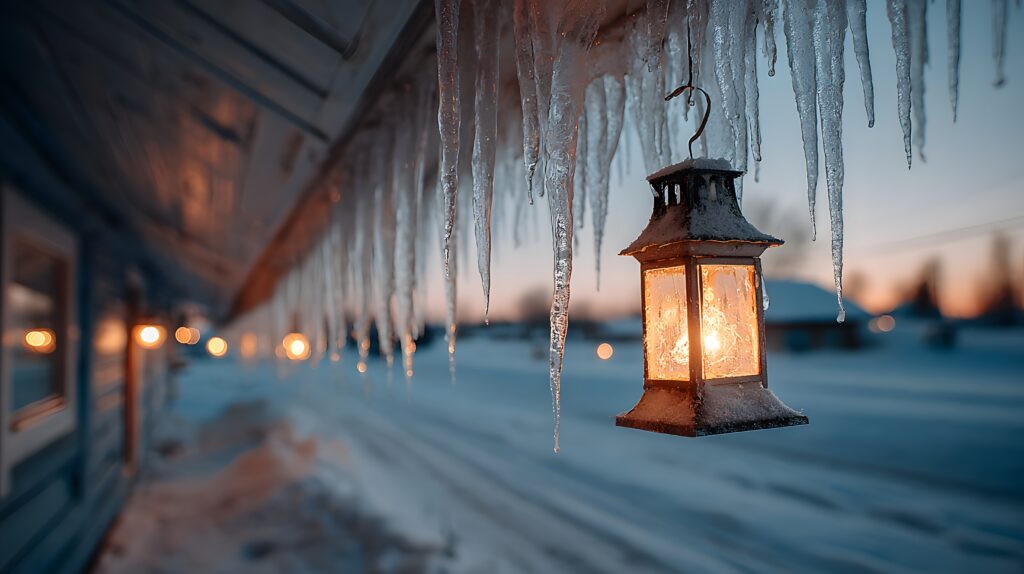
Look closely at icicles hanging from your roof or a tree branch and you’ll often notice something curious: many icicles aren’t perfectly smooth. Instead, they have regular ripples or waves along their length—bumps and grooves spaced evenly, creating a pattern that looks almost decorative, like beads on a string or the segments of bamboo. These ripples appear so consistently that they seem intentional, yet they form naturally through the simple process of water freezing.
For years, these ripples puzzled scientists. Icicles form from the same basic process—dripping water freezing in cold air—so why wouldn’t they be smooth? The answer, discovered relatively recently through careful observation and mathematical modeling, reveals an elegant instability in the freezing process itself, where tiny irregularities amplify into regular patterns through a feedback loop between flowing water and growing ice.
How Icicles Grow
To understand the ripples, you first need to understand basic icicle formation. Icicles grow when liquid water flows down their surface and freezes before it can drip away. This happens when water is warmer than the surrounding air—perhaps from a heated roof or simply from latent heat released as water freezes.
A thin film of water flows down the icicle’s surface, typically just a fraction of a millimeter thick. As this water flows, it loses heat to the cold air around it. Some of the water freezes onto the icicle’s surface, adding a new layer of ice and causing the icicle to grow. The rest continues flowing downward until it either freezes or drips off the tip.
If this process were perfectly uniform along the icicle’s length, you’d expect smooth growth and a perfectly conical icicle. But the ripples reveal that something disrupts this uniformity, creating a pattern in how and where ice deposits.
The Ripple Formation Mechanism
The ripples form through what scientists call a morphological instability—a situation where small irregularities in shape grow larger over time rather than smoothing out. Here’s how it works:
Imagine a tiny bump forms randomly on the growing icicle’s surface. Water flowing down the icicle encounters this bump. The bump creates a slight thickening in the water layer at that point—water accumulates slightly on the upstream side of the bump as it flows around the irregularity.
This thicker water layer insulates the ice beneath it better than the thinner water layer elsewhere. Better insulated ice stays slightly warmer, which slows freezing at that location. Meanwhile, just downstream of the bump, the water layer is slightly thinner than elsewhere because some water was captured by the bump. This thinner layer insulates less effectively, so ice freezes faster there.
The result is that the bump grows slower than the areas immediately above and below it. This creates a depression upstream and enhanced freezing downstream, which begins to form the next bump in the series. The pattern reinforces itself as the icicle grows, creating regular ripples spaced along the length.
Why the Ripples Are Evenly Spaced
The ripples don’t appear randomly—they have remarkably consistent spacing, typically between 1 to 5 millimeters apart depending on conditions. This regularity comes from the physics of the water film and freezing process.
The spacing depends on several factors: the thickness of the water film, the water flow rate, the temperature difference between water and air, and the thermal properties of ice. These factors determine the wavelength at which the instability grows most quickly.
Think of it like waves on a vibrating string: many different wave patterns are possible, but certain wavelengths are naturally favored by the physics of the system. For icicle ripples, there’s an optimal spacing where the feedback between water thickness and freezing rate is most effective at amplifying irregularities.
Scientists have developed mathematical models that predict ripple spacing based on the physical conditions, and these predictions match real icicle measurements remarkably well. The spacing is not random but emerges from the fundamental physics of the freezing process.
Temperature and Flow Rate Affect the Pattern
Not all icicles have the same ripple pattern, and sometimes icicles are smooth. The visibility and spacing of ripples depend on the conditions during formation.
When water flows quickly and the temperature difference between water and air is large, ripples tend to be more pronounced and visible. Fast flow creates thicker water layers and stronger instabilities. Larger temperature differences accelerate freezing and make the effects of varying insulation more noticeable.
When water flows very slowly or temperatures are only slightly below freezing, ripples may be weak or absent. The instability mechanism still operates, but other factors like surface tension and the random nature of ice crystal growth might dominate, producing smoother icicles.
Very cold temperatures combined with moderate flow rates often produce the most visible, regular ripples because conditions favor the morphological instability without overwhelming it with rapid, chaotic freezing.
The Discovery Was Recent
Remarkably, scientists didn’t fully understand why icicles have ripples until the early 2000s. Icicles are such common, everyday objects that you might assume everything about them was understood long ago, but the ripple question remained open for decades.
Research published in the journal Physical Review E in 2006 provided the first complete explanation of the ripple formation mechanism. The researchers used careful observations, laboratory experiments with controlled icicle growth, and mathematical modeling to demonstrate how the morphological instability creates ripples.
This is a reminder that even familiar, seemingly simple phenomena can contain deep physics that takes sophisticated analysis to understand fully. Icicles have hung from roofs for as long as there have been roofs and cold weather, but explaining their texture required modern fluid dynamics and heat transfer theory.
Other Pattern-Forming Instabilities
The morphological instability that creates icicle ripples is similar to instabilities that produce patterns in many other natural systems:
Sand dunes form regular spacing and shapes through instabilities in wind flow and sand transport. Small irregularities in sand height alter wind patterns in ways that amplify the irregularities into dunes.
River meanders develop through instabilities in water flow that cause straight channels to develop curves, which then amplify into dramatic meanders.
Crystal growth often produces regular patterns—dendrites, snowflake branches, and other features—through morphological instabilities where some directions or locations grow faster than others due to feedback between growth and local conditions.
In all these cases, the pattern isn’t imposed from outside but emerges from the growth process itself through instabilities that amplify small variations into large-scale structures.
Not All Bumps Are Growth Ripples
Sometimes icicles have bumps or irregular shapes that aren’t the regular ripples described here. These can form from other causes:
If water flow is intermittent—dripping on and off rather than flowing continuously—the icicle may have irregular bulges or rings that record periods of different growth rates.
If wind blows during formation, it can create asymmetric icicles or irregular surface features by affecting how water flows and where it freezes preferentially.
Multiple icicles growing close together may merge, creating irregular shapes at the junction points.
The regular, evenly spaced ripples are distinctive and different from these other irregularities. They have consistent spacing, appear even when growth conditions are steady, and occur on icicles that are otherwise smooth and well-formed.
Icicle Science Is Still Active
Research on icicles continues because these simple objects involve complex physics. Recent studies have explored:
How salt or impurities in water affect icicle formation and whether they change ripple patterns.
The detailed structure of ice crystals within icicles and how they relate to growth conditions.
Whether ripple formation could be prevented or controlled for applications where smooth ice surfaces are desired.
The similarities and differences between icicle formation and other freezing phenomena like ice stalactites in caves or frost formation on surfaces.
Icicles have even been studied in microgravity experiments on the International Space Station to understand how gravity affects their formation—without gravity, icicles don’t form the same pointed shape because water doesn’t flow downward preferentially.
Why This Matters Beyond Curiosity
Understanding icicle formation has practical implications. Icicles contribute to ice dam formation on roofs, which can cause significant property damage when water backs up under shingles. Better understanding of when and how ice accumulates helps with prevention and mitigation strategies.
The same physics that governs icicle growth applies to other situations where ice forms from flowing water: ice accretion on aircraft, which is a serious aviation hazard; ice formation on ships in cold seas; and ice buildup on power lines and other infrastructure.
The mathematical techniques developed to model icicle ripples have applications in understanding other pattern-forming systems in physics, chemistry, and biology. Many natural patterns emerge from similar morphological instabilities, and insights gained from one system often transfer to others.
The Beauty in Physical Processes
There’s something aesthetically pleasing about icicle ripples—they look almost designed, like decorative glass beads or architectural details. Yet they arise purely from physics, with no designer or purpose. The pattern emerges inevitably from the interplay of flowing water, freezing ice, and heat transfer.
This is one of the remarkable aspects of physics: simple rules operating on simple materials can produce complex, beautiful patterns. The ripples on icicles require no genetic program, no blueprint, no controller. They simply emerge from the mathematics of the freezing process itself.
Looking at Icicles Differently
The next time you see icicles hanging from a roof or tree branch, take a moment to look closely at their surface. If you see those regular ripples—and you often will—you’re looking at a visible record of morphological instability, of a feedback process between water flow and ice growth that amplified tiny irregularities into a regular pattern.
Those ripples are physics made visible. They’re a reminder that even the most ordinary winter phenomenon can contain surprises, and that explaining common observations sometimes requires sophisticated science. Icicles are simple objects—just frozen water hanging in the air—but they’re also complex dynamic systems where fluid flow, heat transfer, and phase changes interact to create patterns that scientists are still working to fully understand.
The ripples transform icicles from simple frozen water into a demonstration of how patterns emerge in nature—not from external design but from the inherent instabilities and feedbacks in physical processes. It’s a small thing, easily overlooked, but it contains layers of beauty both visual and mathematical, hanging from your roof every winter, waiting to be noticed and appreciated.