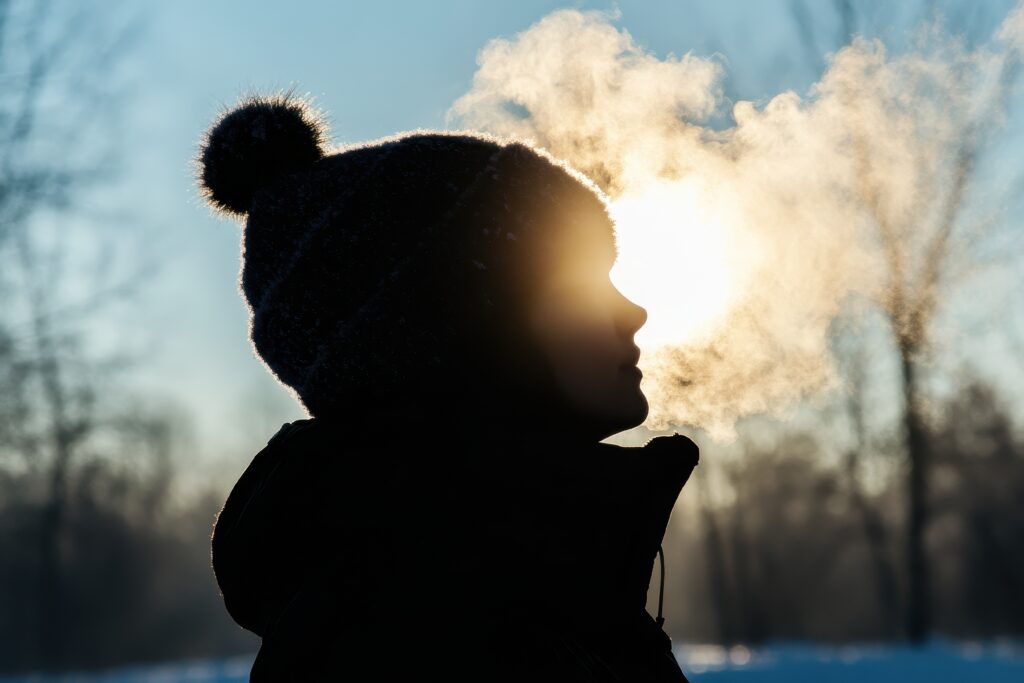
The Cloud You Create With Every Breath
Step outside on a cold winter morning and every breath you exhale becomes visible—a small cloud of mist that appears in front of your face, lingers for a moment, and then dissipates into the air. Children delight in pretending to be dragons breathing smoke. Adults gauge just how cold it is by how long their breath remains visible. This everyday winter phenomenon seems simple, but the process that makes your breath visible involves phase changes, relative humidity, and the unique properties of water vapor.
Understanding why you can see your breath in cold weather reveals fundamental principles about how air holds moisture and what happens when warm, humid air meets cold temperatures. It’s also a visible demonstration of processes happening inside your body with every breath, whether you can see them or not.
Your Breath Is Warm and Humid
Every breath you exhale carries heat and moisture from inside your body. Your lungs are maintained at body temperature—around 98.6°F (37°C)—and the air passages in your nose, throat, and lungs are lined with moist tissue. As air passes through your respiratory system, it picks up water vapor from these moist surfaces and warms to nearly body temperature.
By the time air leaves your mouth or nose, it’s been saturated with moisture. The air you exhale typically has close to 100% relative humidity at body temperature. This is much warmer and contains far more water vapor than the surrounding winter air.
When you exhale, this warm, moisture-saturated air suddenly encounters cold outside air. The temperature difference triggers a rapid change in the air’s ability to hold water vapor, and this is what makes your breath visible.
Temperature Determines How Much Water Air Can Hold
The key to understanding visible breath is recognizing that air’s capacity to hold water vapor depends entirely on temperature. Warm air can hold much more water vapor than cold air—exponentially more, in fact.
At 98°F (near body temperature), air can hold about 50 grams of water vapor per kilogram of air. At 32°F (freezing), that capacity drops to about 4 grams per kilogram. The relationship isn’t linear—each degree of cooling dramatically reduces the air’s ability to hold moisture.
When your warm, humid breath meets cold winter air, it cools rapidly. As it cools, its capacity to hold water vapor plummets. The water vapor that was comfortably dissolved in the warm air suddenly has nowhere to go—the cooled air simply can’t hold that much moisture.
Water Vapor Condenses Into Tiny Droplets
When air becomes saturated—when it’s holding as much water vapor as it possibly can at that temperature—any additional cooling forces some of the water vapor to condense into liquid water. This is exactly what happens when your breath hits cold air.
The water vapor in your exhaled breath condenses into countless tiny water droplets, each one microscopic—typically just a few micrometers in diameter. These droplets are so small that they remain suspended in the air rather than immediately falling. They scatter light in all directions, which is what makes them visible as a white or grayish cloud.
This is the same process that creates fog, clouds, and the condensation you see on a cold glass of water in summer. In all these cases, air saturated with water vapor cools below its dew point (the temperature at which it can no longer hold all its moisture), forcing some vapor to condense into visible liquid droplets.
Your visible breath is essentially a tiny, personal fog cloud that you create with every exhalation.
Why You Can’t See Your Breath in Warm Weather
In warm weather, the outside air is already warm enough that when your exhaled breath mixes with it, the resulting temperature is still above the dew point for the amount of moisture present. The mixed air can hold all the water vapor comfortably, so nothing condenses, and your breath remains invisible.
Even if outdoor air is humid on a warm summer day, the temperature is high enough that the air—both outside and in your breath—can hold large amounts of water vapor without saturation. No condensation occurs, so you see nothing.
This is why visible breath is primarily a cold-weather phenomenon. You need the outside air to be significantly colder than your body temperature to cause the rapid cooling that triggers condensation. Typically, you start seeing your breath when air temperatures drop below about 45°F (7°C), though the exact threshold depends on humidity levels.
Humidity Affects When Your Breath Becomes Visible
The outdoor air’s relative humidity plays a role in whether and how clearly you can see your breath. When outdoor air is very dry, your exhaled breath can mix with more of it before reaching saturation, so condensation may be less dramatic. When outdoor air is already humid, less cooling is needed to reach the dew point, and your breath becomes more visibly cloudy.
This is why you sometimes see your breath more clearly on damp, cold days than on dry, cold days of the same temperature. The pre-existing moisture in the air means that your exhaled water vapor reaches saturation and condenses more readily.
Very cold, dry air (like you might experience in arctic conditions) has such low absolute humidity that even adding your breath’s moisture might not create visible condensation, especially if temperatures are so extreme that your breath freezes into ice crystals rather than condensing into liquid droplets.
Sometimes Your Breath Forms Ice Crystals Instead
When temperatures are extremely cold—typically below about 15°F (-10°C)—the water vapor in your breath may freeze directly into tiny ice crystals rather than first condensing into liquid droplets. This process, called deposition, occurs when water vapor transforms directly to ice without passing through the liquid phase.
Breath that freezes into ice crystals can look similar to condensed breath droplets, but the cloud may have a slightly different appearance—sometimes more sparkly or crystalline if you look closely. In extreme cold, these ice crystals can accumulate on scarves, face masks, or beards, creating a visible buildup of frost.
This is the same process that creates frost on windows and surfaces—water vapor in the air deposits directly as ice crystals when temperatures are below freezing and the surface is cold enough.
The Cloud Dissipates Quickly
Your breath cloud doesn’t last long. The tiny droplets quickly either evaporate back into water vapor as the air warms slightly from mixing with surrounding air, or they continue cooling and freezing if temperatures are cold enough. Within seconds, the cloud disperses and becomes invisible again.
The droplets are small enough that air resistance prevents them from falling. Instead, they drift and mix with the surrounding air, gradually warming or cooling to match ambient temperature. As they warm (through mixing with warmer air or absorbing heat from sunlight), their temperature rises above the dew point and they evaporate, returning to invisible water vapor.
In very calm, cold conditions, you can sometimes see these clouds linger longer and drift slowly away from your face. In windy conditions, they dissipate almost immediately as your breath mixes rapidly with the surrounding air.
Your Breathing Pattern Affects the Cloud
The appearance of your breath cloud varies with how you breathe. A slow, gentle exhalation produces a smaller, less dense cloud that may be barely visible. A forceful exhalation creates a larger, denser cloud because you’re expelling more warm, humid air in a concentrated stream.
Breathing through your nose versus your mouth also makes a difference. Nasal breathing releases air in smaller, more dispersed streams from two nostrils, creating a less dramatic visible effect. Mouth breathing concentrates the exhaled air into a single stream, creating a more visible cloud.
This is why you can enhance the visibility of your breath by exhaling forcefully through your mouth—you’re maximizing the volume of warm, humid air and concentrating it into a visible stream.
Animals and Breath Clouds
Any warm-blooded animal that maintains body temperature above ambient temperature will produce visible breath in cold conditions. Dogs, cats, horses, cattle, and wild animals all create breath clouds in winter for exactly the same reasons humans do.
The size and visibility of the cloud depends on the animal’s body temperature, breathing rate, and the volume of each breath. Large animals like horses exhale larger volumes of air and create more impressive breath clouds. Small animals with faster breathing rates create smaller, more frequent clouds.
Cold-blooded animals like reptiles and amphibians don’t create visible breath because their body temperature matches their environment—their breath isn’t significantly warmer than the surrounding air, so no condensation occurs.
Breath Visibility as a Temperature Gauge
The visibility and persistence of your breath provides a rough gauge of temperature. When you can just barely see your breath and it disappears almost immediately, temperatures are probably in the 40s°F. When your breath creates dense, lingering clouds, temperatures are likely well below freezing.
The color and density of your breath cloud can also provide clues. Very dense, bright white clouds suggest high humidity and temperatures near or below freezing. Thinner, more translucent clouds suggest drier air or temperatures closer to the threshold where breath just barely becomes visible.
People who work or spend significant time outdoors in winter often develop an intuitive sense of temperature based partly on breath visibility—it’s one of several environmental cues (along with how the air feels, how snow crunches underfoot, and how surfaces feel to touch) that experienced winter dwellers use to gauge conditions.
The Same Science Explains Other Condensation
The physics that makes your breath visible explains numerous other everyday condensation phenomena. Steam rising from a hot cup of coffee is water vapor condensing as it meets cooler room air. The fog that fills your bathroom during a hot shower is water vapor condensing as it contacts cooler air and surfaces. The clouds you see in the sky form when rising air cools enough that water vapor condenses.
Even the contrails behind high-flying aircraft form through similar mechanisms—hot, moisture-laden exhaust from jet engines meets extremely cold air at high altitude, causing rapid condensation and sometimes freezing into ice crystals that persist as visible white trails.
A Visible Reminder of Invisible Processes
Seeing your breath in cold air is a rare moment when normally invisible processes become visible. Water vapor—invisible to the human eye—becomes apparent when it condenses. The warmth and humidity your body constantly produces and expels are revealed. The temperature-dependent behavior of air and water vapor is demonstrated with every exhalation.
Next time you step outside on a cold morning and watch your breath form clouds, remember you’re witnessing a miniature demonstration of thermodynamics, phase changes, and the properties of water. You’re creating tiny fog clouds through the simple act of breathing, making the invisible visible for just a few seconds before it returns to invisibility. It’s one of winter’s many reminders that the air around us, though transparent and seemingly empty, is rich with water, energy, and constantly changing physical processes.