Nature’s Perfect Cones
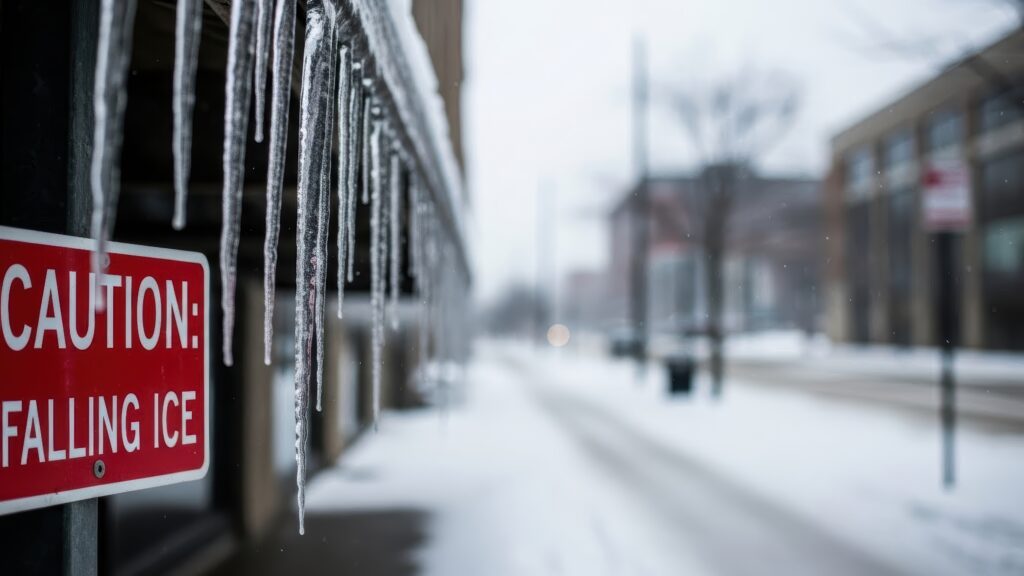
On cold winter days, icicles hang from roof edges, tree branches, and any surface where dripping water meets freezing temperatures. Nearly all icicles share the same distinctive shape: they’re thick at the top where they attach, then taper smoothly to a sharp point at the bottom. This consistent geometry appears so reliably that you rarely see blunt or irregularly shaped icicles—yet water freezing in a container forms flat surfaces, not points.
The pointed shape of icicles isn’t random or accidental. It emerges from the interplay of gravity, heat transfer, surface tension, and the physics of flowing water as it freezes. Understanding why icicles form points reveals elegant principles about how matter behaves at the boundary between liquid and solid states.
Icicles Form From Flowing Water, Not Still Water
The key to understanding icicle shape is recognizing that they don’t form from water that’s simply sitting still and freezing. Icicles grow from water that’s flowing—dripping down from above, moving along the surface of the growing ice, and forming new ice as it travels.
Water flowing over a roof absorbs heat from the warmer roof surface or from the sun, even when air temperatures are below freezing. This slightly warmed water reaches the roof’s edge and begins to drip. As it drips and flows down the icicle’s surface, it loses heat to the surrounding cold air. Some of this water freezes onto the icicle before it can drip away, adding a new layer of ice and causing the icicle to grow.
The water doesn’t freeze all at once. It remains liquid as long as it’s moving and in contact with the relatively warmer ice underneath. Only when the water slows down or stops does it have enough time to transfer its heat to the cold air and freeze solid.
Gravity Pulls Water Downward and Creates the Shape
As water flows down the surface of a growing icicle, gravity pulls it toward the tip. The water layer is thin—often just a fraction of a millimeter—and clings to the ice surface through molecular attraction and surface tension.
Near the top of the icicle where it attaches to the roof edge, the circumference is large and water is constantly replenished from above. The water has plenty of surface area to spread across, so the layer is relatively thin and flows quickly downward. Quick-flowing water has less time to freeze, so less ice is added in this region.
As water flows downward and the icicle diameter decreases, the same amount of water must flow across a smaller circumference. This forces the water layer to become thicker. Thicker water layers lose heat more slowly because the water farther from the cold air is insulated by the water closer to the air. The thicker water layer freezes more slowly, and more of it drips away rather than freezing in place.
This creates a feedback loop: regions where the icicle is thicker have more water flowing over them, which freezes less efficiently, which limits further thickening. Regions where the icicle is thinner have faster-flowing water in thinner layers, which freezes more completely, which causes that region to grow faster. The result is that the icicle tapers smoothly from thick at the top to thin at the bottom.
Surface Tension Creates the Sharp Tip
The pointed tip of an icicle forms because of surface tension—the property that makes water droplets bead up and allows some insects to walk on water. Surface tension arises from the mutual attraction of water molecules, which creates a kind of “skin” on the water’s surface.
At the bottom of a growing icicle, water flowing down the surface accumulates at the tip. Surface tension tries to minimize the surface area of this water, pulling it into the smallest possible shape. For a hanging drop of water, the shape that minimizes surface area while being pulled downward by gravity is approximately conical with a rounded bottom.
As water accumulates at the tip, it forms a pendant drop held by surface tension. When the drop becomes heavy enough, it detaches and falls, leaving behind a thin neck of water. This neck quickly freezes before the next drop can form, creating the sharp point characteristic of icicles.
The freezing happens so quickly at the very tip because the water there is exposed to cold air from all sides, not just one side as water higher up the icicle is. This all-around exposure allows rapid heat loss and fast freezing, preserving the pointed shape created by surface tension.
Temperature Determines Icicle Growth Patterns
The exact shape of an icicle depends on the balance between water flow rate and freezing rate, both of which depend on temperature. When temperatures are just below freezing, water flows relatively fast and freezes slowly, producing long, slender icicles with very sharp points. Most of the water flows all the way to the tip before freezing, allowing the icicle to extend downward rapidly.
At colder temperatures, water freezes more quickly, and more ice is deposited along the icicle’s length rather than only at the tip. This produces shorter, thicker icicles that still taper to a point but have a less dramatic taper angle.
When temperatures fluctuate—warming during the day and freezing at night—icicles can develop ripples or bulges along their length. These features record the history of changing conditions: periods of faster flow and slower freezing alternate with periods of slower flow and faster freezing.
Why Icicles Don’t Form Other Shapes
You might wonder why icicles always taper smoothly rather than forming cylinders, spheres, or irregular lumps. The physics simply doesn’t allow those shapes to persist.
If an icicle somehow started growing as a cylinder with constant diameter, the water flowing down it would maintain a constant thickness. But any slight variation—a small bump or depression—would immediately create a feedback effect. A bump would cause water to thin and freeze faster above it, preventing further growth and creating a taper. A depression would cause water to pool and freeze slower, filling in the depression and restoring a smooth taper.
Similarly, spherical growth is impossible because water flows downward under gravity rather than accumulating uniformly in all directions. Gravity ensures that growth happens preferentially downward, creating the elongated, pointed shape.
The pointed icicle shape is what mathematicians call an attractor—a stable state that the system naturally moves toward regardless of small perturbations or variations in starting conditions. This is why nearly all icicles look fundamentally similar despite forming under slightly different conditions.
Ripples and Waves on Icicle Surfaces
Many icicles aren’t perfectly smooth. They have regular ripples or wave-like patterns spaced evenly along their length. These ripples form through an instability in the flow and freezing process, similar to how sand dunes form regular spacing due to wind patterns.
Scientists have studied these ripples and found they form when water flowing down the icicle’s surface encounters tiny irregularities in the ice. These irregularities disrupt the smooth flow, causing the water to freeze preferentially in certain locations. The spacing between ripples depends on the water flow rate, temperature, and other factors, but typically ranges from a few millimeters to a centimeter.
The ripples don’t affect the overall tapered, pointed shape—they’re a smaller-scale feature superimposed on the basic icicle geometry. But they demonstrate that even seemingly simple phenomena like icicle formation involve complex fluid dynamics and phase changes.
Hollow Icicles and Strange Variations
Occasionally, you might encounter an icicle that’s hollow—ice on the outside with an air cavity or water channel running through the center. These form when water flows fast enough that the outside freezes first, creating an ice shell while water continues to flow through the interior.
If the water supply is then cut off before the interior freezes, you’re left with a hollow icicle. These are more common in specific conditions like water dripping from a pipe where flow rates can be high and then suddenly stop.
Clusters of icicles often form when water drips from multiple points along a roof edge or gutter. Each icicle grows according to the same physical principles, but they may connect and merge if they’re close enough, creating curtains of ice rather than individual spikes.
Stalactites Follow Similar Physics
The physics governing icicle formation is similar to what creates stalactites in caves, though the timescales are vastly different. Stalactites form when mineral-laden water drips from cave ceilings and deposits dissolved minerals as it evaporates or chemically changes. Like icicles, stalactites taper to points for the same fundamental reasons: gravity pulls material downward, flow patterns determine where material is deposited, and surface tension influences the tip shape.
The difference is that stalactites grow over thousands of years as minerals slowly accumulate, while icicles form in hours or days as water freezes. But both demonstrate how simple physical principles create similar shapes in entirely different contexts.
The Mathematical Elegance of Ice
Icicles represent a beautiful example of how complex, elegant shapes emerge from simple physical laws. No blueprint or plan guides icicle formation—just gravity, heat transfer, fluid flow, and surface tension, all operating simultaneously.
The reliable appearance of the same tapered, pointed shape across countless icicles in diverse conditions demonstrates a deep principle: when physical processes are constrained by fundamental laws, certain patterns become inevitable. The shape of an icicle is as unavoidable as the hexagonal symmetry of snowflakes, though it arises from completely different physics.
Next time you see icicles hanging from a roof edge or tree branch, take a moment to appreciate that you’re looking at frozen water that has organized itself into a mathematically predictable shape through nothing more than physics playing out at the boundary between liquid and solid, warm and cold, flowing and frozen. It’s one of winter’s many reminders that nature creates beauty through simple rules operating in complex ways.