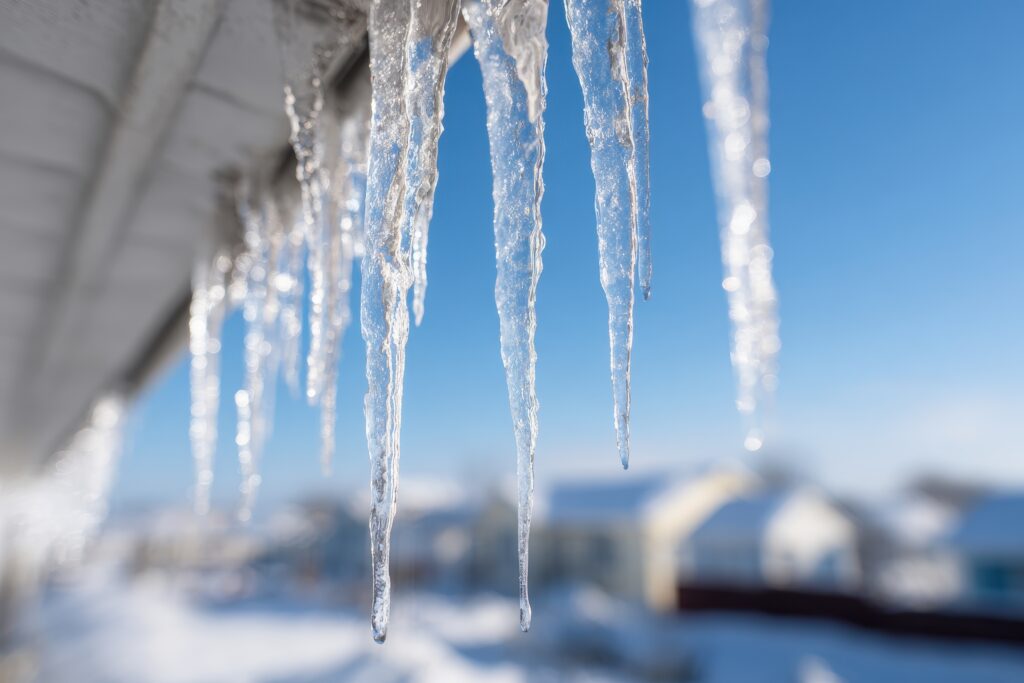
Understanding What Creates Nature’s Frozen Sculptures on Roof Edges and Overhangs
Walk past buildings on a winter day and you’ll see icicles hanging from roof edges, gutters, and overhangs—but not randomly. They form in regular, repeating patterns: a large icicle, then smaller ones, then another large one, spaced out along an edge with surprising regularity. Some grow straight down while others angle dramatically. Some are smooth and transparent while others are rippled and cloudy. These frozen spikes aren’t random ice formations but follow predictable physics governing heat transfer, water flow, and crystal growth. Understanding why icicles form in specific patterns reveals principles of fluid dynamics, thermodynamics, and the geometry of ice crystal formation.
Icicles Require Two Things: Dripping Water and Freezing Temperatures
The basic requirements for icicle formation are simple but specific:
Water must be flowing or dripping from a surface. Still water that freezes doesn’t form icicles—it creates ice sheets or coatings.
Air temperature must be below 32°F (0°C) so that dripping water freezes before falling away completely.
Heat from above provides the melt water. This typically comes from poor roof insulation allowing warm air to heat the roof and melt snow, or from solar heating during the day followed by refreezing at night.
The water source must be sustained for extended periods. A brief drip produces only small ice bulges; dramatic icicles require hours of continuous dripping and freezing.
The right temperature range produces the best icicles—cold enough to freeze dripping water but not so cold that all water freezes before reaching the edge, cutting off the drip supply.
When these conditions align, water flows to an edge, begins dripping, freezes partially while dripping, and builds downward drop by drop into the elongated formations we recognize as icicles.
Why They Form at Regular Intervals
The spacing of icicles along a roof edge isn’t random:
Surface tension causes water flowing along an edge to break into discrete drip points rather than flowing uniformly. Just as water from a faucet breaks into separate drops, water flowing along a roof edge concentrates at specific points.
Rayleigh-Plateau instability is the physics principle explaining why flowing fluids break into droplets. A thin sheet of water flowing along an edge is unstable and spontaneously organizes into separate streams at regular intervals.
The spacing depends on water flow rate, surface properties of the edge, and edge geometry. Smooth edges create more regular spacing than rough edges.
Once a drip point forms and begins building an icicle, it tends to capture water flowing nearby, reinforcing itself and preventing new drip points from forming too close. This creates the characteristic spacing pattern.
Typical spacing is often 6-12 inches between major icicles on residential roofs, with smaller intermediate icicles sometimes filling gaps.
This pattern isn’t precise—variations in roof edge conditions, flow rates, and temperature create irregularities—but the underlying physics pushes toward regular spacing.
How Icicles Grow
The growth process follows specific steps:
Initial formation: Water drips from an edge and freezes where it contacts the cold surface, creating a small ice bulge or stub.
Downward growth: Additional water flows over the stub, and the coldest part—the tip extending into cold air—freezes first, extending the icicle downward.
Radial growth: While the tip extends downward, water flowing down the sides partially freezes, thickening the icicle.
The process is self-reinforcing. The icicle’s shape naturally channels flowing water down its length toward the tip, concentrating flow where growth is most rapid.
Growth rate depends on water supply rate and air temperature. More water and colder air produce faster, thicker icicles.
Equilibrium is eventually reached where water dripping from the tip equals water freezing onto the icicle, stopping growth until conditions change.
The classic icicle shape—thick at top, tapering to a point at bottom—reflects this growth pattern with maximum ice accumulation where water first contacts the cold surface and minimum at the tip where water spends least time freezing before dripping away.
Why Some Are Smooth and Others Rippled
Icicle surface texture reveals their formation history:
Smooth, clear icicles form from slow, steady water flow in very cold conditions. Water freezes gradually with minimal air bubble inclusion, creating transparent ice.
Rippled or ridged icicles develop when flow rate varies periodically. Changes in water supply create rings or ridges as ice accumulates faster during heavy flow periods and slower during reduced flow.
Cloudy, white icicles contain trapped air bubbles from rapid freezing or turbulent water flow. Fast-freezing water doesn’t allow air to escape, creating opaque ice.
Icicles with internal structure—concentric rings visible if you look closely—record variations in formation conditions over time, somewhat like tree rings recording growth seasons.
External ripples spaced at regular intervals along the icicle’s length can form from wind effects or from periodic variations in drip rate caused by thermal cycling.
Temperature’s Critical Role
The ambient temperature determines what type of icicles form:
Just below freezing (30-32°F): Icicles grow slowly, are often thick and stubby because much of the water drips away before freezing.
Moderately cold (20-30°F): Ideal conditions for dramatic icicle formation. Cold enough to freeze effectively but warm enough to maintain water flow from above.
Very cold (below 10-15°F): Icicle formation slows or stops because the water source freezes before reaching edges. Existing icicles may remain but don’t grow.
Fluctuating temperatures create the most interesting icicles—melting during warmer periods provides water, freezing during colder periods builds ice.
Day-night cycles with above-freezing days and below-freezing nights create optimal conditions—daytime melting provides abundant water that refreezes at night into substantial icicles.
Why Icicles Often Indicate Problems
While icicles are aesthetically pleasing, their presence often signals issues:
Poor roof insulation allows heat to escape, warming the roof and melting snow even when air temperature is below freezing. This melt water flows to cold eaves and refreezes as icicles.
Ice dams often accompany icicles. The same heat loss and melting that creates icicles also creates ice dams that can damage roofs and cause water infiltration.
Energy waste is occurring. Heat escaping through your roof is heating outdoor air instead of your home.
Clogged gutters can cause water to overflow and refreeze as icicles rather than draining properly.
Ideal roofs in winter have no icicles because the roof surface stays at outdoor temperature—no melting occurs, so no water flows to edges to refreeze.
This is why building professionals view icicles as warning signs of insulation problems, not charming winter decorations.
The Physics of the Pointed Tip
Icicles’ characteristic sharp point results from specific physics:
Water flowing down the icicle reaches the tip as the coldest part extending farthest into frigid air.
Surface tension shapes the hanging drop at the tip into a sphere, but freezing occurs preferentially at the bottom of the drop—the coldest point.
As ice forms on the bottom of the drop, it extends the icicle downward in a pointed shape that’s thermodynamically favorable.
The equilibrium shape is a pointed cone because this geometry maximizes surface area for heat loss (promoting freezing) while minimizing volume (concentrating the structure).
Mathematical models of icicle formation reproduce the natural pointed shape by solving equations for heat transfer, fluid flow, and ice deposition—demonstrating that the shape emerges naturally from physical laws.
Stalactites vs. Icicles
Icicles resemble cave formations but form through different processes:
Stalactites in caves grow over thousands of years from mineral-rich water dripping and depositing calcite or other minerals—slow chemical deposition.
Icicles grow in hours to days from pure water freezing—fast physical phase change.
The similar shape reflects similar physics—both form from dripping fluid that deposits material while dripping—but the timescales and mechanisms differ dramatically.
Ice caves can form icicles that persist for years, blurring the distinction, but typical icicles are seasonal and melt completely each spring.
Dangerous Icicles
Large icicles pose genuine hazards:
Weight of major icicles can reach hundreds of pounds. These falling from height can cause serious injury or property damage.
Sharp points make falling icicles particularly dangerous—they’re essentially frozen spears.
Clusters breaking simultaneously create especially hazardous conditions as multiple heavy ice spikes fall at once.
Warning signs of dangerous icicle accumulation include very large formations, icicles hanging over walkways or entryways, and sounds of cracking or ice shifting.
Removal should be done carefully from safe positions, never by standing directly beneath or using methods that could cause sudden release of large ice masses.
Building codes in some jurisdictions require measures to prevent dangerous icicle formation over entryways.
Icicles in Art and Culture
The distinctive forms of icicles have inspired humans throughout cold-climate cultures:
Decorative motifs in architecture and design often reference icicle shapes.
Winter photography frequently features icicles for their visual appeal and association with winter beauty.
The sound of dripping icicles melting in spring is a traditional marker of seasonal change, appearing in poetry and literature.
Crystal chandeliers deliberately evoke icicle shapes, bringing winter’s frozen beauty indoors as permanent decoration.
Observing Icicle Formation
To watch icicles grow:
Identify formation conditions—snow-covered roof with heat loss, temperatures around 25-30°F, sunny days followed by cold nights.
Observe over days as icicles extend from small stubs to major formations.
Note spacing patterns and how water flow concentrates at specific points.
Photograph at different stages to document growth.
Break one open (safely, after it falls) to examine internal structure—you might see concentric layers recording formation history.
Nature’s Temporary Sculptures
Icicles represent one of winter’s most visible intersections of thermodynamics, fluid dynamics, and crystallography—processes that transform dripping water into elongated ice spikes through principles of heat transfer, surface tension, and crystal growth. The patterns they form—regular spacing along edges, characteristic pointed shapes, variable textures recording formation conditions—aren’t artistic choices but physical inevitabilities emerging from the laws governing water, ice, and heat.
Next time you see icicles hanging from a roof edge, look beyond their immediate beauty to recognize the physics at work: heat escaping through the roof melting snow, meltwater flowing to cold eaves, surface tension organizing flow into discrete drip points, freezing water building downward drop by drop in shapes determined by thermodynamics and geometry. They’re temporary ice sculptures that will disappear with the next warm spell, but while they exist, they demonstrate elegant physical principles—fluid instability creating regular spacing, optimal heat loss geometry creating pointed tips, and freezing dynamics creating the familiar tapering form that makes icicles instantly recognizable as winter’s signature decoration.