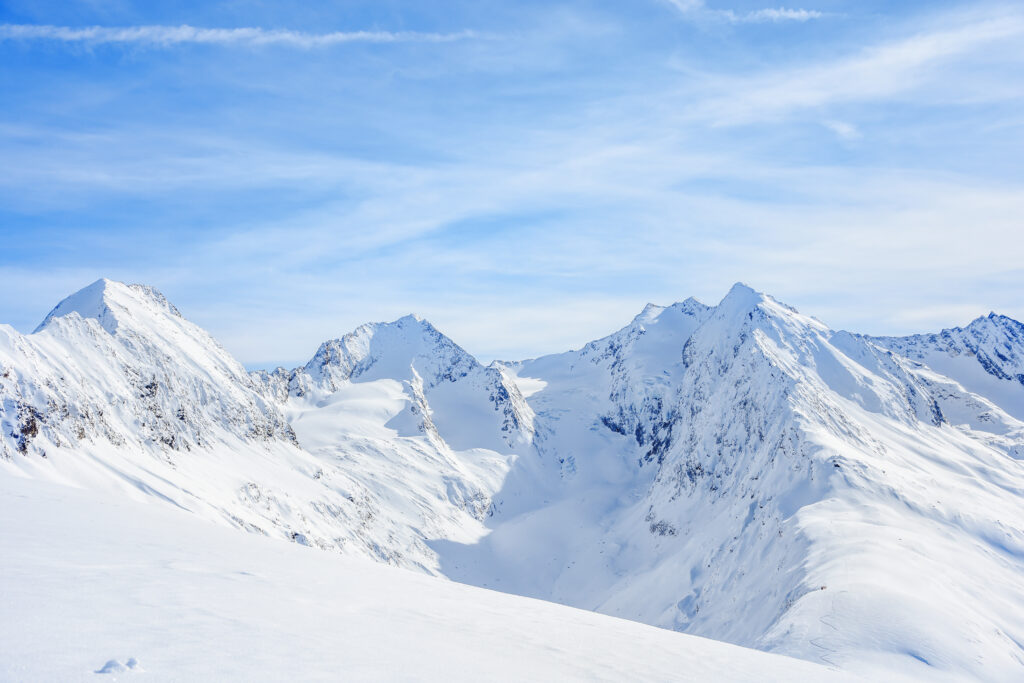
Understanding How Altitude Changes Everything About Snowfall
Drive from a valley floor to a mountain summit during winter and you might pass through multiple weather worlds—from rain at low elevations, to a rain-snow mix partway up, to heavy snow at the top, all within a 20-30 minute drive covering just a few thousand feet of elevation gain. Mountains don’t just receive more snow than valleys; they receive fundamentally different snow under different atmospheric conditions. Understanding how elevation affects temperature, precipitation type, snowfall amounts, and snow characteristics reveals why mountain snow behaves so differently from the snow that falls in valleys and lowlands.
Temperature Drops with Elevation
The most fundamental difference between mountain and valley conditions is temperature:
The standard atmosphere cools approximately 3.5°F per 1,000 feet of elevation gain (about 6.5°C per kilometer). This is the environmental lapse rate—how temperature decreases as you ascend through the atmosphere.
This means if a valley at 1,000 feet elevation is experiencing 40°F temperatures, a mountain summit at 6,000 feet—just 5,000 feet higher—would be around 22°F, nearly 20 degrees colder.
Rain/snow line positioning depends critically on this temperature gradient. The elevation where temperature reaches 32-34°F determines where rain changes to snow. On any given day, this line might be at 2,000 feet, 4,000 feet, or 7,000 feet depending on the overall temperature profile.
Small elevation changes matter. A difference of 500-1,000 feet can mean the difference between rain and snow, or between light snow and heavy snow. Mountain residents learn their local patterns—”below 3,000 feet usually gets rain while above 4,000 feet gets snow” or similar rules of thumb.
This guaranteed temperature difference means mountains receive snow when valleys see rain, extending the snow season by weeks or months at higher elevations. Mountain snow seasons might run October through May while valley snow is limited to December through March.
Mountains Wring Out Moisture
Beyond temperature, mountains extract much more precipitation from passing storms through orographic lifting:
Air forced upward over mountain barriers must rise, and rising air cools. As air cools, its capacity to hold moisture decreases, forcing water vapor to condense and precipitate.
Windward slopes (the side facing oncoming weather systems) receive dramatically enhanced precipitation—often 2-3 times what nearby valleys receive, sometimes even more.
The Cascade Range, Sierra Nevada, and Rockies all demonstrate this effect. Westerly storms dump enormous snow amounts on western-facing slopes while eastern slopes and valleys receive much less.
Leeward slopes (downwind side of mountains) experience a “rain shadow” effect. Air descending the far side warms and dries, reducing precipitation. This is why areas east of the Cascades or Rockies are much drier than western slopes.
Elevation matters for total precipitation independent of rain versus snow. Higher elevations simply squeeze more moisture from passing air masses, so even if both a valley and summit see snow, the summit gets more of it.
Snow Characteristics Differ by Elevation
The quality and character of snow varies with altitude:
Colder temperatures at elevation produce lighter, drier snow with higher snow-to-liquid ratios. Snow at 8,000 feet might be champagne powder with 15:1 or 20:1 ratios, while the same storm at 2,000 feet produces heavy, wet snow at 8:1 ratios.
Less melting and refreezing occurs at high elevations where temperatures stay consistently below freezing. Mountain snow stays powdery and loose while valley snow goes through multiple melt-freeze cycles that create crusts and ice layers.
Wind exposure at elevation affects snow structure. Strong winds on exposed mountain slopes create wind-packed snow, wind slabs, and cornices. Valley snow is less affected by wind.
Sun intensity increases with elevation due to thinner atmosphere. Solar radiation melts and transforms mountain snow even when air temperature stays below freezing, creating unique snow surface conditions.
Crystal types that form vary with the temperature and humidity conditions at different elevations, affecting everything from how snow bonds to slopes (avalanche risk) to how it feels under skis or boots.
Avalanche Danger Increases with Elevation
Mountain snow brings hazards rarely encountered in valleys:
Steep terrain combined with heavy snow accumulation creates avalanche conditions. Valley snow on gentle slopes is stable; the same snow on 35-degree mountain slopes can slide catastrophically.
Wind loading transports snow from windward to leeward slopes, creating dangerous accumulations and unstable slabs on lee sides of ridges and in certain slope aspects.
Weak layers in mountain snowpack—buried surface hoar, depth hoar, or faceted crystals—create avalanche hazards that can persist for weeks or months.
Temperature gradients within mountain snowpack are steeper than in valley snow due to greater surface-to-ground temperature differences, promoting weak layer formation.
Terrain traps like gullies, tree wells, and cliffs make even small avalanches potentially fatal in mountains while valley avalanches are rare and less consequential.
Mountain snow requires completely different safety considerations than valley snow. Backcountry travelers must understand snowpack evaluation, avalanche terrain recognition, and rescue techniques—concerns irrelevant to valley snow enthusiasts.
Persistence and Accumulation
Mountain snow accumulates and persists very differently:
Seasonal snowpack in mountains can reach 10-20 feet deep or more, with accumulation building throughout winter. Valley snow rarely exceeds a few feet and often melts between storms.
Snow remains longer at elevation due to consistently cold temperatures. Mountain snow from November might still be present in June or July, while valley snow from the same storm melted weeks earlier.
Compaction creates dense layers as seasonal snowpack weight compresses lower layers. Spring mountain snowpack might have density approaching ice in lower layers while surface snow remains relatively fresh.
Glaciers form on mountains where snow accumulation exceeds melting year after year, creating permanent ice features. No such features exist in valleys—snow always melts completely during warmer months.
Multiple Snow Zones in One Storm
A single storm system can produce completely different conditions at different elevations:
Valleys might see rain at 1,000-2,000 feet while mountains at 5,000 feet receive heavy snow.
Mid-elevations (2,000-4,000 feet) might experience the most difficult conditions—rain changing to snow, heavy wet snow, or repeated transitions between rain and snow as the freezing level fluctuates.
High elevations above 6,000-7,000 feet receive consistent snow throughout the storm with no rain mixing, producing the lightest, driest conditions.
Forecasting challenges multiply because small temperature changes shift these zones vertically by hundreds of feet, completely changing impacts at specific elevations.
This vertical complexity makes mountain weather forecasting extremely difficult and explains why elevation-specific forecasts are essential in mountain regions.
Inversions Flip the Script
Occasionally, temperature inversions reverse normal elevation patterns:
Cold air pools in valleys while warmer air resides at higher elevations. This can create situations where valleys are colder than mountains, sometimes by 20-30°F.
Valley fog and low clouds during inversions can produce freezing drizzle or light snow in valleys while mountain slopes bask in sunshine.
These inversions are most common during high-pressure systems with calm conditions, not during active storms, but they demonstrate that elevation/temperature relationships aren’t always straightforward.
Accessing Mountain Snow
The differences between valley and mountain snow affect recreation and transportation:
Ski resorts exist at elevation precisely because of reliable, high-quality snow that valleys don’t receive. A resort at 8,000-10,000 feet might operate November through April with excellent conditions while valley areas see intermittent snow.
Mountain passes close or require chains/snow tires when valleys are seeing rain or bare pavement. Driving conditions can change dramatically over short distances as you gain elevation.
Backcountry access requires specialized equipment, knowledge, and fitness. Valley snow might be accessible with boots and warm clothes; mountain snow demands avalanche training, proper gear, and physical capability to navigate steep, deep snow.
Water Resources Depend on Mountain Snow
The differences between mountain and valley snow have enormous practical importance beyond recreation:
Mountain snowpack is critical water storage for millions of people. Western U.S. water supplies depend on high-elevation snowpack melting gradually through spring and summer.
Valley snow melts quickly and runs off during winter, contributing little to reservoir storage or summer water availability.
Snow surveys focus on high-elevation snow specifically because that’s what matters for water supply. Valley snow is irrelevant to regional water resources despite being what most people see daily.
Climate change affecting mountain snowpack—earlier melting, more rain instead of snow, reduced accumulation—has far greater implications than similar changes in valley snow simply because mountain snow serves as essential water storage.
Forecasting Complexity
Predicting mountain snow challenges meteorologists:
Elevation-specific forecasts are essential but difficult to create accurately. A forecast of “8-12 inches” might apply above 6,000 feet while 3,000 feet receives 2-4 inches and valleys get rain—but the exact elevation bands shift with storm dynamics.
Local effects from terrain complexity, aspect (north-facing vs. south-facing slopes), wind patterns, and microclimates create enormous variability that even high-resolution models can’t fully capture.
Snow level fluctuations during storms—the freezing level rising and falling by 1,000+ feet—make impacts uncertain even when storm systems are well-forecast.
Multiple elevation zones requiring different forecasts mean mountain forecasts are inherently more complex than valley forecasts covering areas with minimal elevation variation.
Understanding Your Elevation
If you live in or visit mountainous areas:
Know your elevation and how it relates to typical snow levels for your region.
Understand that elevation rules are local. The Pacific Northwest, Rockies, and Appalachians all have different typical snow level elevations based on regional climate.
Pay attention to elevation-specific forecasts rather than regional generalities.
Recognize the signs—when valleys have rain but clouds on nearby mountains look white and puffy, snow is falling at elevation even if you’re not seeing it where you are.
Two Different Worlds
Valley snow and mountain snow might as well be different phenomena. They form under different temperature regimes, accumulate in vastly different amounts, possess different physical characteristics, create different hazards, and persist for different durations. The 3.5°F per 1,000 feet temperature drop combines with orographic lift and altitude effects to create completely separate winter weather environments at different elevations—often within visual range of each other.
Next time you’re in mountain country during winter, pay attention to how conditions change with elevation. That rain in town becomes snow just a few thousand feet up. That light snow at mid-elevations is heavy powder at the summit. Those slopes that look gentle from the valley are steep enough for avalanches up close. Mountain snow isn’t just “more snow”—it’s fundamentally different snow in a fundamentally different environment, governed by the same physics and meteorology but producing dramatically different results than its valley counterpart just a short drive away.